Achilles tendonitis can feel like it comes out of nowhere. One day you’re moving fine and the next, you’re dealing with stiffness, pain, and that frustrating “tight” feeling at the back of your ankle. Rest only does so much, and let’s be frank, you have a lot you want to do. This guide walks you through a proven 6-step Achilles tendonitis treatment plan you can start today to reduce pain, improve mobility, and rebuild strength.
Why Achilles Tendonitis Happens in the First Place
Your Achilles tendon connects your calf muscles to your heel. When your calves become tight and overworked they start pulling on that tendon. Over time, that constant tension builds irritation, stiffness, and pain. If nothing changes, it can progress into more serious injury. That’s why effective treatment isn’t just about the tendon. It needs to involve everything connected to it, especially your calves.

The 6-Step Achilles Tendonitis Treatment Plan
These steps are designed to work in order, building on each other for the best results. That being said, you don’t have to do everything if you don’t have all the tools.
1. Start With a Warm-Up (Not Stretching)

Before jumping into treatment, you need to prepare the tissue. If your achilles is really uncomfortable, walking or jogging might feel more irritating than good. Use a massage gun on your calf and Achilles area for 2–3 minutes instead!
This helps:
- Increase blood flow
- Reduce stiffness
- Decrease pain sensitivity
Key tip: Avoid going directly on the most painful spot! No need to make it more irritated.
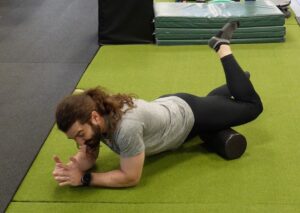
2. Foam Roll to Release Tight Calves

Once the area is warmed up, move into foam rolling for 1-2 mins
Focus on:
- Calf muscles (gastrocnemius + soleus)
- Slow, controlled movements
- After the initial 60 seconds pause on tight spots with dynamic movement for 5 reps
This step helps:
- Break up adhesions
- Improve tissue quality
- Reduce pulling on the tendon
3. Use Muscle Flossing to Improve Circulation

Muscle flossing is one of the most underrated tools!
Wrap a muscle flossing band around:
- The calf or
- The Achilles
Then perform movement (like ankle pumps or calf raises) for 60–90 seconds.
Why it works:
- Restricts then Enhances blood flow
- Helps clear out irritation
- Improves mobility under load
4. Muscle Scraping

Using a muscle scraping tool:
- Work along the calf and Achilles
- Use light to moderate pressure
- Spend about 2 minutes total
Benefits:
- Breaks down scar tissue
- Improves circulation
- Promotes healing response
Important: More pressure does not always equal better results. Bruising is not your end goal. If you’re looking for a muscle scraper Sidekick tools are our favorite!
5. Stretch the Right Way

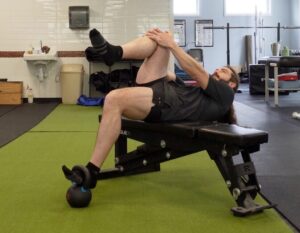
Static stretching isn’t always the best option. For this we want to re-introduce lengthening the tissue and to do that we want to do it a little bit at a time.
Dynamic stretching:
- Elevate your toes (step, plate, or wedge)
- Fold forward over your toes – this drives your knee forward over your toes
- Alternate bending and straightening the knee
This targets:
- The full calf complex
- The Achilles tendon through range
Result:
- Better flexibility
- Less strain on the tendon
6. Strengthen With Negative Calf Raises
Negative (eccentric) calf raises are one of the most effective ways to treat Achilles tendon issues.
How to do it:
- Raise up on both feet
- Shift weight to the injured side
- Slowly lower down
Why it matters:
- Builds tendon strength
- Improves load tolerance
- Reduces recurrence risk
Eccentric loading is a key part of tendon rehab – you definitely don’t want to skip this step!

Putting It All Together
This entire routine takes about 20 minutes.
You can do it:
- Daily (if tolerated)
- Or every other day if you’re sore
Consistency is what drives results.
Most people start noticing improvements quickly—but real tissue changes take 4–6 weeks.
Watch The How To Video:
Common Mistakes That Slow Recovery
- Only stretching – its a good start but doesn’t have the whole picture you need
- Skipping strength work – this is the glue that will keep you from getting reinjured
- Overdoing it – doing too much is like not doing enough!
- Ignoring calf tightness – pretending like it’s not there doesn’t make it go away!
Achilles tendonitis treatment works best when you combine tissue work, mobility, and strength. That’s why you should be using a combination of these to help you get rid of your achilles tendonitis for good!
When to Get Help
If you think you have achilles tendinitis or you’re suffering from achilles pain it’s best to consult a doctor or physical therapist to help you.
Especially if your pain:
- Isn’t improving after a few weeks
- Is getting worse
- Or is limiting daily movement
Achilles tendonitis can be stubborn, but it responds well when you’re using the right approach. If you stay consistent with this 6-step plan, you’re not just reducing pain—you’re rebuilding a stronger, more resilient tendon.
More Achilles Resources
Check out our other blog on Achilles tendonitis anatomy and treatment here!
Are you local to the Lehigh Valley and Bethlehem, PA? Come in and see us at Mobility-Doc for your sports physical therapy needs!